The story behind the server
Old Hendriksen
and the Lighthouse
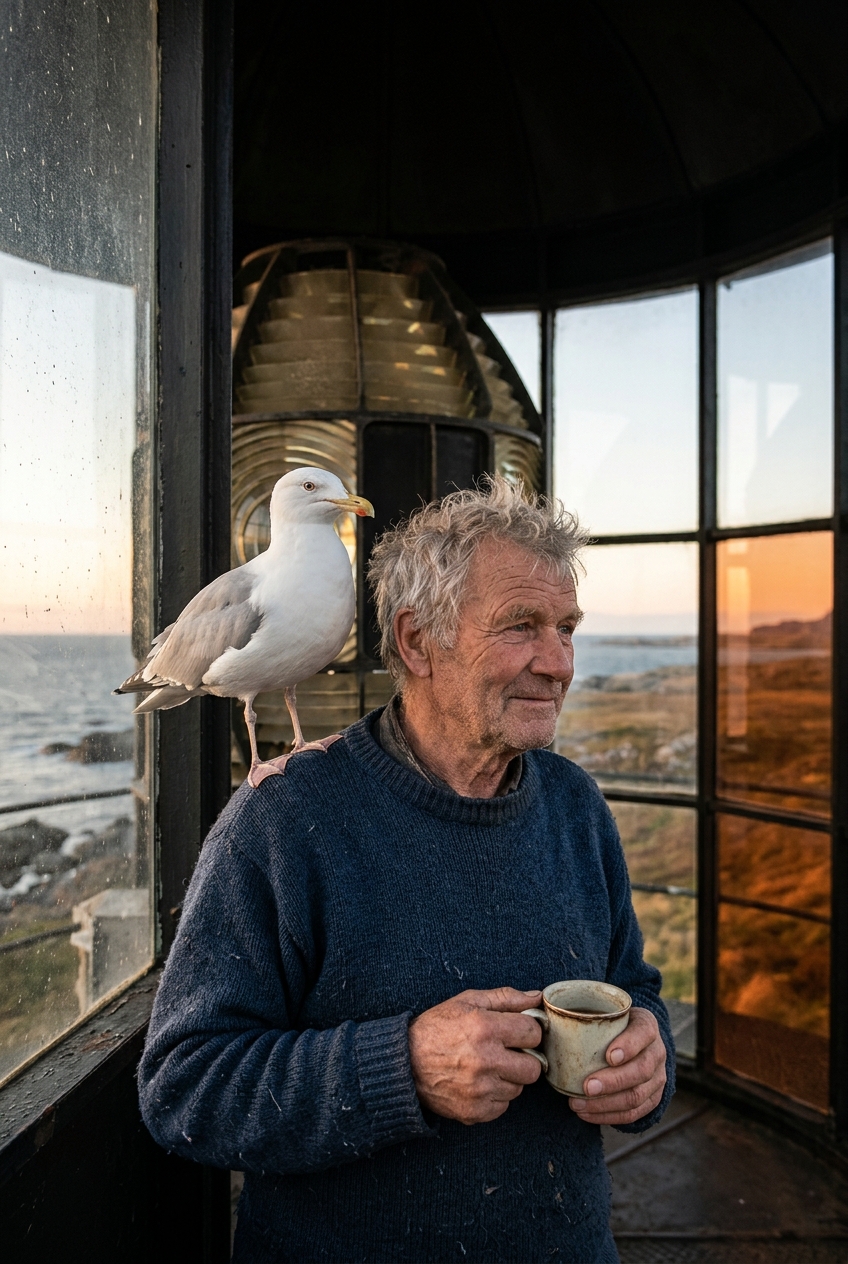
Photograph taken by nobody in particular.
Nobody really knows how old Magne Hendriksen is. He doesn't know either. He stopped counting sometime in the late nineties — the decade, not his age — when a fishing trawler deposited him, a crate of mismatched ethernet cable, and three very confused herring gulls at the base of Brennøy Lighthouse on the western coast of Norway. The trawler never came back. The gulls never left.
The lighthouse had been decommissioned in 1986, its automated beacon replaced by a solar-powered buoy that bobbed indifferently a hundred metres offshore. The lighthouse keeper's quarters were empty. The basement — a low-ceilinged, salt-damp room carved directly into the granite headland — smelled of diesel and old rope and something faintly electrical that Magne found deeply comforting. He carried his server rack down the spiral staircase himself, one shelf at a time, pausing on each landing to watch a new squadron of herring gulls wheel and shriek over the grey-green water below. There were always gulls. In summer, thousands of them: a white, bellowing, fish-scented blizzard that blotted out the horizon. In winter, a stubborn few dozen who simply refused to acknowledge that conditions had become unreasonable.
The basement stays cold year-round, which Magne considers ideal. "Servers don't like to be warm," he explains to the gulls, who don't care. The largest of them — a barrel-chested patriarch he calls Halvard, distinguished by a notch in his left wingtip and a personality that could charitably be described as aggressive — has learned to tap the window glass with his beak when the amber LED on rack unit three starts blinking. Magne has never been able to determine whether Halvard understands what the blinking means, or whether he simply enjoys the sound. Either way, it works.
Power comes from a cable Magne ran himself along the base of the cliff in 2003, spliced into a substation that services four farms and a ferry terminal. The ferry terminal is seasonal. The farms mostly do sheep. Nobody has ever questioned Magne's electricity consumption, possibly because nobody at the utility company has ever looked at the account name — Brennøy Fyr & Fiskeri AS, registered in 1948 — and thought to wonder.
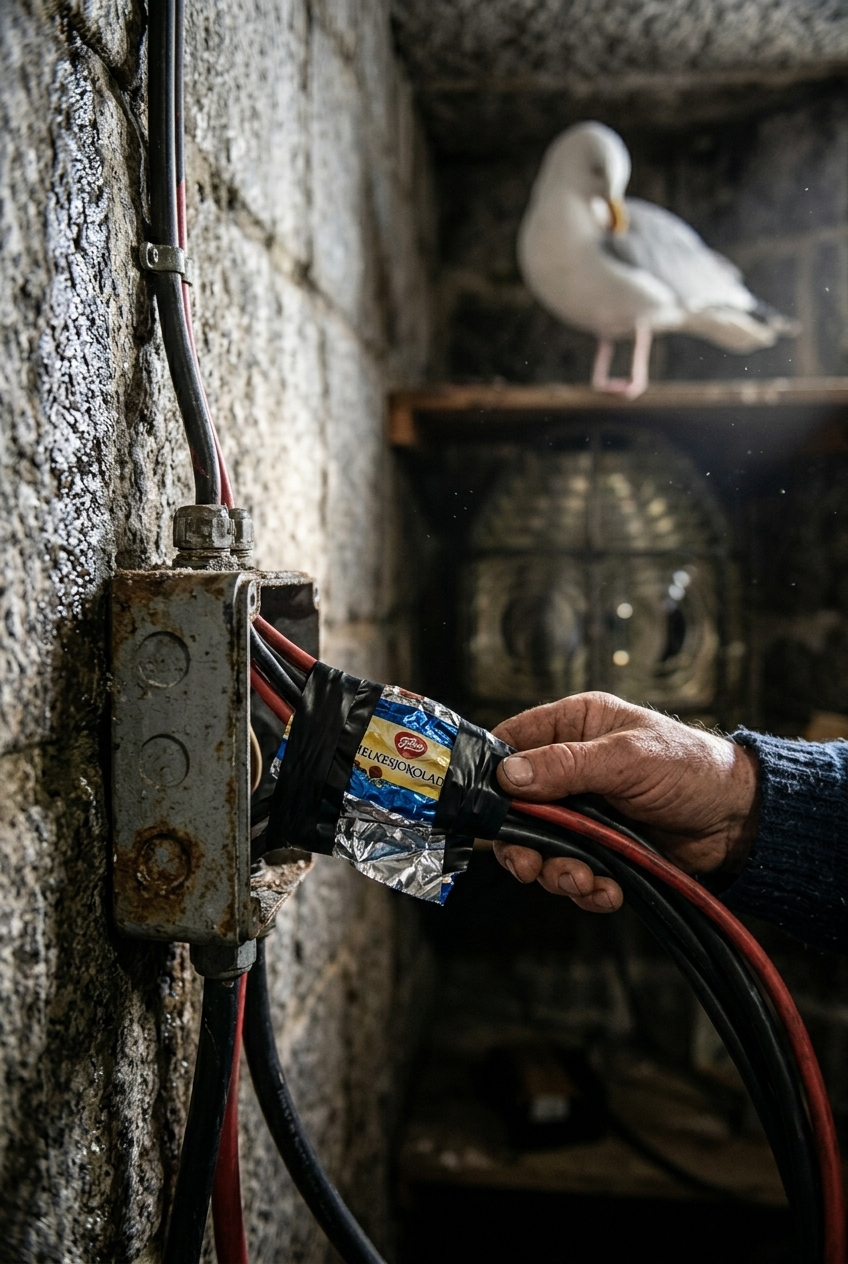
Connectivity is a more colourful story. The original ADSL line came via a cable buried under two kilometres of coastal heathland. It ran at 512 kilobits per second and took seventeen days to provision. Over the years, Magne has upgraded it, cajoled it, replaced entire sections of it himself with cable he ordered from a marine supply catalogue, and once — during a particularly bad storm in January 2017 — repaired a junction box with electrical tape and the foil from a chocolate wrapper while Halvard stood on his shoulder and screamed into the wind. They now have a 1Gbit fibre connection, which Magne regards with the quiet satisfaction of a man who has earned it.
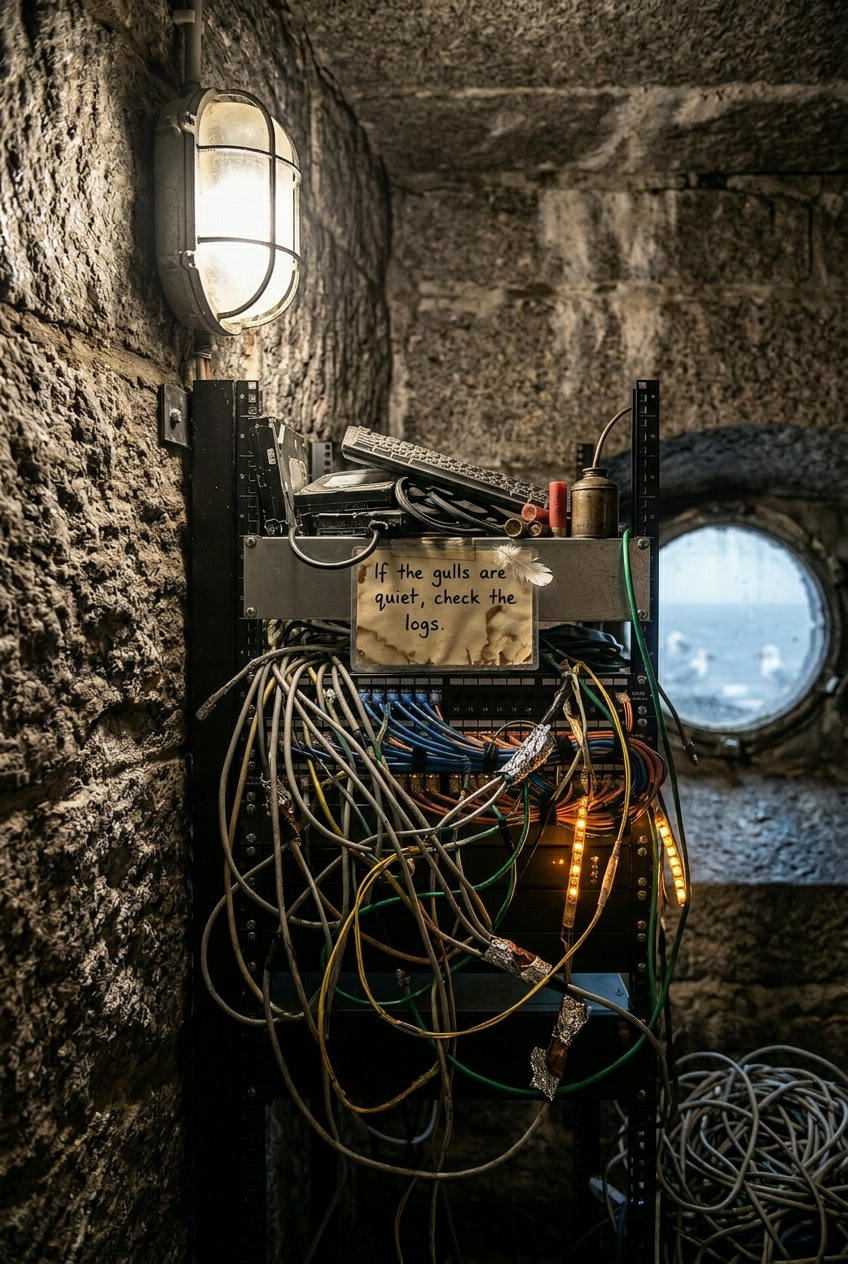
FlickFlock runs on three rack-mounted servers in that basement. The racks are bolted to the granite wall. The cables are very tidy. On the shelf above the patch panel there is a laminated card that reads, in Magne's cramped handwriting: "If the gulls are quiet, check the logs." Gulls are never quiet, so the logs are usually fine.
On clear evenings, after the last ferry has gone and the heathland has turned the colour of old rust in the low sun, Magne climbs to the lantern room — the light itself has been dark for forty years, but the lens is still there, enormous and dusty and somehow magnificent — and watches the flock settle on the water below. Hundreds of birds, maybe more, rafting together on the swell in a loose, murmuring mass that shifts and reforms with each wave. He has been watching them for decades. He does not pretend to understand them. He finds this reassuring.
The name FlickFlock is his. He suggested it in an email written at 2 a.m. during a storm that had knocked out the ferry terminal and left him alone with the gulls and the hum of the servers and a very large pot of coffee. Nobody expected him to be good at naming things. He surprised everyone, including himself.
Brennøy Lighthouse, western Norway. Latitude 61°N. The gulls are always there.